


"King of the Beijing Drum-song" Liu Baoquan
【CMHnews Post】Learning Chinese Quyi with Me (2)
Writer:RenMei Wang
"Where does the drum come from?"
Beijing Drum-song is one of the major Quyi (traditional storytelling and singing) forms of northern China. Yet long before it was known by this name, drum-accompanied storytelling already existed.
In the Southern Song dynasty, the poet Lu You wrote in “Little Boat Wandering Near the Village Cottage — Returning by Boat, Part Four”:
At sunset on the old road by Zhao Village, A blind old man performs, drum upon his back. Who cares for right and wrong behind the tale? The whole village listens to Cai Zhonglang.
The poem vividly depicts a folk storyteller performing with a drum, showing that drum-based storytelling was already well established by the Song dynasty.

The Folk Origins of the Wooden Clapper
Drum-Song
Beijing Drum-song did not exist from ancient times. Its predecessor was known as wooden clapper drum-song, which emerged in the late nineteenth century in the Hejian and Cangzhou regions of Hebei province. It was a form of rural self-entertainment: one drum, no elaborate accompaniment, storytelling through song.
As social upheaval intensified around the turn of the twentieth century, rural livelihoods collapsed. Many performers migrated to cities along two main routes: one toward Tianjin via Hejian and Cangzhou, the other toward Beijing via Baoding. In the cities, drum-singing became a means of survival. Blind performers traveled through alleys and courtyards, earning a living by fortune-telling or singing drum-songs.

From Local Dialects to the Beijing Accent
and Melody
At that time, the three most well-known performers of the wooden clapper drum-song around Beijing and Tianjin were Hu Shi (Hu Jintang), Song Wu (Song Yukun), and Huo Mingliang.
Around 1912, Liu Baoquan arrived in Beijing. He originally sang in the Hejian regional dialect, but under the guidance of the great Peking opera artist Tan Xinpei, he realized that local accents limited urban audiences’ understanding. Liu gradually adopted the Beijing accent and incorporated operatic rhythm, phrasing, and character portrayal. This new style was first called Jingyin Dagu and later became known as Jingyun Dagu (Beijing Drum-song).
The Birth of the “King of the Beijing Drum-Song”
In the history of Beijing Drum-song, Liu Baoquan is a milestone figure. He was known in his own time as the “King of Drum-song,” not merely for his virtuosity, but for accomplishing a crucial artistic transformation.
He reshaped the regional wooden clapper drum-song into a refined art form grounded in Beijing pronunciation and aesthetics. Under his influence, Beijing Drum-song rose from folk entertainment to the centerpiece of Beijing storytelling venues.
Contemporary Audience’s Genuine Impressions
In 1921, the newspaper Jingbao published an article by Feng Shuluan titled Liu Baoquan’s Drum-Song, offering a rare first-hand listener’s account. The author recalled hearing Liu in Tianjin and missing him deeply in Beijing. Upon learning of Liu’s performance at Sihai Shengping, he eagerly attended.
Pieces such as Ningwu Pass: Farewell to Mother and Storm of Arrows were described as solemn and tragic, leaving a lasting resonance. One line became famous: “If Liu Baoquan is not performing, the southern teahouses are hardly worth visiting.”

Repertoire, Recordings, and Concerns
About Legacy
Liu Baoquan’s repertoire exceeded two hundred works, including Changban Slope, Ningwu Pass, Single Saber Meeting, Black Dragon Court, and Borrowing Arrows with Straw Boats, which remain central today. In the early twentieth century, the French Pathé company recorded his performances, allowing Beijing Drum-song to be preserved and disseminated through sound recordings.
Yet despite his fame, Liu worried deeply about the art’s future. Drum-song demands total exposure: one performer, one drum, one clapper, one string—no place to hide weakness. This rigor made his achievement monumental, but also difficult to inherit.
Biography | Liu Baoquan
Liu Baoquan (c. 1868–1938) was a leading Beijing Drum-song performer and founder of the Liu school. Born Liu Shunquan, courtesy name Yimin, he was a native of Shen County, Hebei. Educated in classical studies, he learned wooden clapper drum-song through folk performance.
Active in Beijing and Tianjin during the late Qing and early Republican periods, he refined his art under Tan Xinpei’s guidance, transforming wooden clapper drum-song into Beijing Drum-song. Recorded by Pathé, he earned the title “King of Drum-Singing” and established the influential Liu school. Beyond Beijing Drum-song, Liu Baoquan was celebrated for his “Three Masteries”: Pi-pa performance, Shi-yun singing, and Ma-tou tune singing.

Listening Recommendation: Beijing Drum-song “Capturing Sanlang Alive”
Today, I would like to share a classic piece from the Liu School, “Capturing Sanlang Alive.” This performance features a tight plot and vivid characters and is one of the important representative works of the Liu School Beijing Drum-song. Next time, we will introduce Bai Yunfeng, the founder of the Bai School of Beijing Drum-song, along with his representative works, helping you understand his unique contributions and style to this art form.
Listening link (rare footage):
About the Author
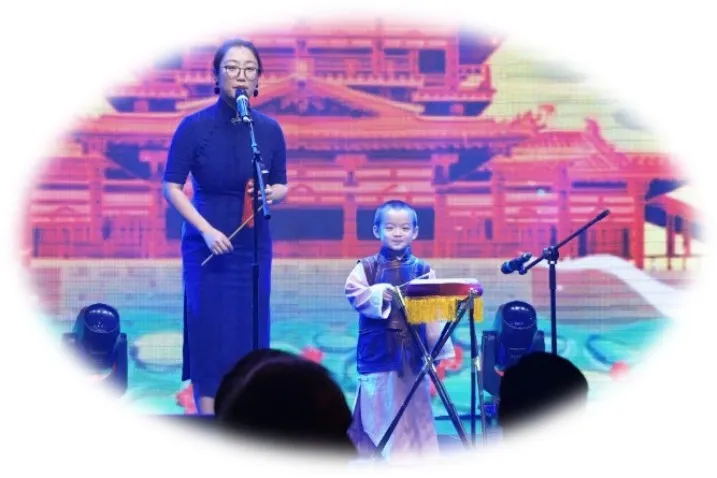
Renmei Wang (Cheryl Wang) holds an M.A. in East Asian Studies from the University of Toronto. Based in Canada, she is a cultural advocate for Chinese Quyi and traditional performing arts, as well as a radio host and journalist. She has long studied and shared Chinese Quyi, with a focus on contemporary expression and cross-cultural exchange in multicultural settings. She has received culture grants support through the Edmonton Arts Council and the Edmonton Heritage Council and has pursued advanced training in China under the guidance of professional Quyi artists specializing in Northern Chinese storytelling drum-songs.
《天时周刊》官网站
我们一起看世界!


Comments