


The Global Position of Canada's Northern City

【CMHnews Post】A Global Vision for a Winter City ,from Ice and Snow to Artifificial Intelligence: How Edmonton Positions Itself in Global Urban Competition?
Edited & Reported by Lynn Wang
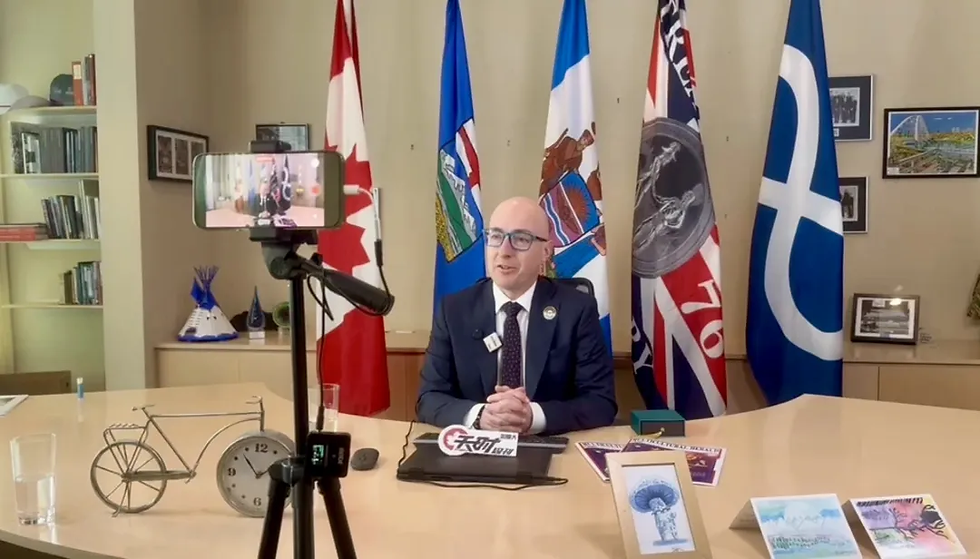
On January 23, 2026, CMH News (Multicultural Herald) conducted its fifirst in-depth interview of the year with Edmonton Mayor Andrew Knack at City Hall. This marked the publication’s fifirst face-to-face mayoral interview of 2026 at Edmonton’s municipal government.
The interview began with Edmonton’s Winter City Strategy, extended to higher education and technological innovation, and ultimately addressed community revitalization and cultural spaces. Drawing on his recent participation in the World Mayors Dialogue in Harbin, Mayor Knack compared Edmonton with Harbin as two representative winter cities, and outlined how Edmonton is positioning itself in the global urban landscape by leveraging climate, talent and international partnerships.
From Defence to Offence: Winter as a Competitive Advantage
Speaking about winter city development, Mayor Knack reiterated a core message he delivered in Harbin: “The modern winter city must shift its mindset from one of defence to one of offence — seeing climate not as a barrier but a platform for innovation, a catalyst for culture and a competitive advantage.”
He noted that this shift is already underway in Edmonton. “We didn’t want winter to be something that people simply endured, but rather embraced and recognized.”
Since the launch of Edmonton’s Winter City Strategy, the city’s focus has moved beyond merely “getting through” winter, toward creating opportunities for residents to experience and enjoy the season. One visible example is the outdoor skating rink in front of City Hall, a simple initiative that has encouraged residents to return to public spaces during winter and strengthened community participation.
“We’re seeing more and more community leagues in Edmonton actually put on winter festivals and events, where it used to only happen in the spring, summer and fall. Now people are embracing that.”
A Post-Secondary Hub: Edmonton’s Talent Advantage
Reflflecting on his visit to Harbin Institute of Technology’s Space Museum, Mayor Knack spoke highly of Harbin’s university system.
“I think it’s 800,000 students that were talking about.”
The fifigure prompted him to reconsider Edmonton’s own position in the global education landscape. Edmonton is home to the University of Alberta, MacEwan University, NAIT, NorQuest College and other institutions, with strong capabilities in artifificial intelligence, engineering, automation and the broader STEM fifields.
“Our post-secondary institutions really complement one another. We become the postsecondary hub of Canada, I think it’s safe to say at this point.”
Mayor Knack emphasized that future economic competitiveness depends increasingly on talent concentration rather than physical resources. “If you’re looking for talent, Edmonton is the right space in North America to fifind that hub.”
He also shared a personal experience: for more than 12 years, he has participated in international student programmes, typically speaking three times a year to groups of students from China who study in Edmonton for about four months. “It’s a great opportunity for me to hear from people who have a different way of looking at things, and at the same time getting to share our expertise and knowledge.”
Ice and Snow Culture: Harbin’s Experience Coming to Edmonton?
In discussing winter culture and sports, Mayor Knack revealed a potential cultural collaboration: “Is there an opportunity next winter to bring in some of the sculptures, the artists who create these amazing ice sculptures, for the Ice and Snow Festival, and do some of that here?”
He also suggested that Edmonton landmarks could one day appear as ice sculptures in Harbin’s famous festival. “I talked about this with Mayor Wang as well… maybe there’s an opportunity at the next Ice and Snow Festival to have an Edmonton building as one of the buildings on display.”
He noted that Edmonton and Harbin share similar climates, making winter tourism between the two cities especially viable. “There’s a lot of great events almost every weekend. There’s something going on in the winter that people can experience.”
On sports, Harbin is widely known as the “City of Olympic Champions,” while Edmonton ranks:
• No. 1 sports host city in Canada
• No. 22 globally
“Why not invite more and more athletes from across the world, in particular from Harbin and the rest of China, to come show their incredible talents for all Edmontonians? And at the same time, we can have some of our athletes go out there.”
He sees international sports exchanges as a major future growth opportunity for city diplomacy.
Edmonton in the Global Landscape: A Midsize City with Global Reach
Referring to recent comments by Canadian Prime Minister Mark Carney at the World Economic Forum in Davos — that in today’s global economy, countries are “either at the table or on the menu” — Mayor Knack was asked how Edmonton should position itself in an increasingly competitive global environment.
He described Edmonton as a city that has traditionally been viewed as mid-sized, and likely will remain so for some time, even as it continues to grow. “Edmonton has sort of always been considered a midsize city, and I actually think that’s where we’ll be for a while, even as we continue to grow.”
Mayor Knack said he found the Prime Minister’s remarks particularly thoughtprovoking, especially when applied to cities like Edmonton. “We’re not going to be anytime soon as big as some of the largest cities in North America. So this is why it’s so important for a midsize city to be working with other cities that are also working to build up those names and fifind their own talents and strengths.”
Rather than competing purely on scale, he argued that Edmonton’s strategy lies in specialization — particularly in higher education and innovation. “We are the post-secondary hub. We’re producing probably, I think at this point, it’s easy to say the best talent in all of the country, of any city.”
He highlighted Edmonton’s position in artifificial intelligence research as a prime example: “We are second in Canada and fififth in the world in AI research.” This global ranking, he said, opens up signifificant opportunities for long-term development.
“You think about what that allows us to do as we go forward. So even though we’re a midsize city, there are a number of areas where we go and punch well above our weight.” According to Mayor Knack, Edmonton’s future depends on continuing to strengthen its core advantages while actively seeking new partnerships and learning opportunities.
“It’s leaning into those strengths and then again fifinding those partnership opportunities, those learning opportunities to help advance areas where maybe we don’t have quite as great of a strength, and turning that into a strength over time.” He concluded by expressing strong confifidence in Edmonton’s global potential, particularly through international cooperation.
“I am very excited about Edmonton’s potential, and I’m excited about how Edmonton’s potential will grow as we work with other cities across the world — in particular with our sister city in Harbin.”
Revitalizing Chinatown: A Strategic Urban Priority
In the fifinal segment, Mayor Knack responded to a question from CMH News community outreach specialist Cheryl Wang regarding the Chinatown Vibrancy Fund.
He confifirmed that the City has increased funding for the programme, supporting murals, artistic installations, cultural festivals and community initiatives. “The whole point of the Chinatown Vibrancy Fund is to provide additional opportunities for more people to experience what Chinatown has to offer.”
Mayor Knack noted that City Hall is located close to Chinatown, and that he visits almost weekly. “It’s an incredible place in our city, and more and more people need to experience it.”
While acknowledging Chinatown’s current vitality, he expressed a longer-term vision: “I very much envision a time in the future where we’ll return to that place where people say, ‘Chinatown is the spot to come.’”
From Harbin to Edmonton, from ice sculpture exchanges to artifificial intelligence, from international sports to global city partnership, the interview revealed more than a policy agenda — it reflflected a broader transformation in urban identity. Edmonton is no longer positioning itself as a city that simply adapts to external conditions, whether climate or global competition. Instead, it is redefifining itself as a city that actively shapes its role on the world stage.
Not by size, but by talent.
Not by isolation, but by partnership.
Not by enduring winter, but by embracing it.
As Mayor Knack concluded: “What embracing winter and being on offence about winter looks like.” For Edmonton, this is no longer a metaphor — it is becoming a strategic reality.
《天时周刊》官网站
我们一起看世界!



Comments